Am 6. September 2026 wählt Sachsen-Anhalt einen neuen Landtag, am 20. September folgen Berlin und Mecklenburg-Vorpommern. Ein Blick auf die aktuellen Wahlumfragen macht klar: Die Regierungsbildung im Anschluss an den Wahltag wird aller Voraussicht nach nicht einfach. Denn die politischen Mehrheitsverhältnisse lassen sich vermutlich nicht über Nacht in eine tragfähige Koalition übersetzen. Sofern nicht die AfD eine absolute Mehrheit erreichen sollte, wird daher eine Zusammenarbeit von Parteien nötig, die ideologisch weit voneinander entfernt sind. Die verfassungsrechtlichen Vorgaben zur Regierungsbildung in den drei Ländern haben unterschiedliche Folgen, die auch weiter in die Regierungszeit hineinwirken können. Denn starre Fristen können zu einer instabilen und schwach legitimierten Regierung führen. Daher gilt: Schneller ist nicht besser!
Von Hinterzimmer-Runden zu komplexen Strukturen
Eine Regierungsbildung mit ihren Sondierungsgesprächen und Koalitionsverhandlungen dauert. Diese Prozesse sind zwar nirgends formal festgelegt, sie haben sich aber in den vergangenen Jahrzehnten in Bund und Ländern ständig weiter ausdifferenziert und inzwischen faktisch verstetigt. Basierten sie früher auf vertrauensvollen Hinterzimmer-Runden zwischen den Parteiführungen, werden heute komplexe Strukturen aufgebaut, die mindestens aus Hauptverhandlungsgruppen und politikfeldbezogenen Arbeitsgruppen bestehen. So sind viele parteiinterne Akteure eingebunden, die verschiedene Strömungen, Regionen und teilweise auch unterschiedliche Ebenen des politischen Systems vertreten: Es ist nicht unüblich, dass einzelne Mitglieder des Bundestags an Koalitionsverhandlungen auf Landesebene teilnehmen – und umgekehrt verhandeln Landesvertreter meist im Bund mit. Ferner wird der Prozess innerparteilich strukturiert, teilweise ist das in den Parteisatzungen vorgegeben: Bereits Zwischenergebnisse von Sondierungen werden festgehalten und veröffentlicht, und fertigen Koalitionsverträgen muss die Partei zustimmen, manchmal sogar per Mitgliedervotum. Das alles braucht Zeit.
Sachsen-Anhalt, Mecklenburg-Vorpommern und Berlin haben gemeinsam, dass sie Schwesterverfassungen aus ähnlichen Gründungsjahren nach der Wiedervereinigung haben – und doch gehen sie mit der Herausforderung einer potenziell langen Regierungsbildungsphase heute recht unterschiedlich um.
Sachsen-Anhalt: Mechanische Fristauslösung
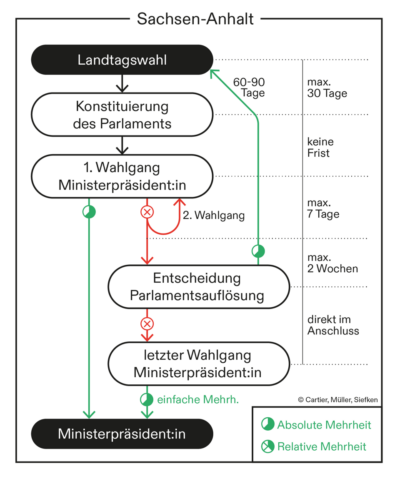
In Sachsen-Anhalt muss sich der neue Landtag am 30. Tag nach der Wahl konstituieren (Art. 45 Abs. 1 Satz 2 der Verfassung des Landes Sachsen-Anhalt (Verf ST)). Wann der neu konstituierte Landtag den Ministerpräsidenten wählen muss, gibt die Landesverfassung nicht mehr vor. Das war mal anders: Bis zur Parlamentsreform 2020 musste die Ministerpräsidentenwahl innerhalb von 14 Tagen nach der konstituierenden Sitzung des Landtags stattfinden. Heute regelt die Landesverfassung hingegen bloß, dass der Landtag den Ministerpräsidenten ohne Aussprache wählt (Art. 65 Abs. 1 Verf ST). Implizit setzt das aber voraus, dass zu diesem Zeitpunkt bereits eine Mehrheit feststeht – sonst würde eine Wahl ohne Vorstellung und Diskussion reine Zufallsergebnisse produzieren.
Art. 65 Abs. 2 Satz 1 Verf ST legt fest, dass zum Ministerpräsidenten im ersten Wahlgang gewählt ist, wer die Stimmen der Mehrheit der Mitglieder des Landtags erhält. Findet sich im ersten Wahlgang keine Mitgliedermehrheit, greift eine Mechanik: Innerhalb von sieben Tagen findet dann ein zweiter Wahlgang statt. Damit definiert die Verfassung eine zeitliche Obergrenze, innerhalb derer der Landtag einen weiteren Wahlgang vorzunehmen hat.
Kommt die Wahl mit der Mitgliedermehrheit auch im zweiten Wahlgang nicht zustande, dann muss der Landtag innerhalb von weiteren 14 Tagen über die vorzeitige Beendigung der Wahlperiode entscheiden. Lehnt der Landtag die Beendigung ab, findet unverzüglich ein weiterer Wahlgang statt. Gewählt ist dann, wer die Mehrheit der abgegebenen Stimmen erhält (Art. 65 Abs. 2 Satz 5 Verf ST). So kann ein Ministerpräsident gewählt werden, der nur die Mehrheit der abgegebenen Stimmen erhält („einfache Mehrheit“), nicht aber die Mehrheit der Mitgliederstimmen („absolute Mehrheit“). Bevor in Sachsen-Anhalt eine Minderheitsregierung möglich wird, muss der Landtag also stets über seine eigene Auflösung entscheiden.
Mecklenburg-Vorpommern: Starre doppelte Fristenlösung
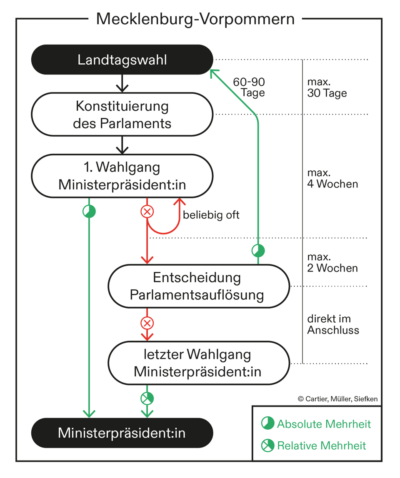
Wie in Sachsen-Anhalt muss sich der Landtag in Mecklenburg-Vorpommern spätestens am 30. Tag nach der Wahl konstituieren (Art. 28 Satz 1 der Verfassung des Landes Mecklenburg-Vorpommern (Verf MV)). Nach Art. 42 Abs. 1 Verf MV wählt der Landtag den Ministerpräsidenten ohne Aussprache und mit der Mehrheit seiner Mitglieder in geheimer Abstimmung. Bedeutsam ist Art. 42 Abs. 2 Satz 1 Verf MV: Ist die Wahl nicht innerhalb von vier Wochen nach dem Zusammentritt des neugewählten Landtags erfolgreich, beschließt der Landtag innerhalb von zwei weiteren Wochen über seine Auflösung. Die Auflösung kann der Landtag nur mit der Mehrheit seiner Mitglieder beschließen. Dem liegt der Gedanke zugrunde, einer möglichst stabilen Regierung den Weg zu ebnen.
Im Gegensatz zu Sachsen-Anhalt ist in Mecklenburg-Vorpommern also kein dezidierter zweiter Wahlgang vorgesehen, der dieselben Mehrheitserfordernisse aufstellt, wie der erste. Das liegt vermutlich schlicht daran, dass der Landtag innerhalb der Vier-Wochen-Frist eine beliebige Anzahl an Versuchen unternehmen kann, einen Ministerpräsidenten zu wählen. Art. 42 Abs. 3 Satz 1 Verf MV bestimmt weiter, dass – sofern der Landtag nicht die Beendigung der Wahlperiode beschließt – am selben Tag ein weiterer Wahlgang stattfindet. Gewählt ist dann, wer die meisten Stimmen erhält („relative Mehrheit“). Damit besteht in Mecklenburg-Vorpommern die Vorgabe, die neue Exekutivspitze innerhalb von ca. 10 Wochen (30 Tage + 28 Tage + 14 Tage) zu wählen. Dies ist verfassungsrechtlich bindend: Wenn es nicht gelingt, findet zunächst die Auflösungsentscheidung des Landtags statt, und wenn der Landtag die Auflösung nicht beschließt, dann wählt er eine Minderheitsregierung. Es gibt also in Mecklenburg-Vorpommern eine feste zeitliche Obergrenze für die abschließende Entscheidung über eine neue Regierung oder Neuwahlen: Nach ca. 10 Wochen muss sie getroffen sein.
Berlin: Maximale Flexibilität für die Regierungsbildung
In Berlin muss das Abgeordnetenhaus spätestens sechs Wochen nach der Wahl erstmalig zusammentreten (Art. 54 Abs. 5 Satz 2 Verfassung von Berlin (VvB)). Es wählt danach mit der Mehrheit seiner Mitglieder den Regierenden Bürgermeister, der vergleichbar mit den Ministerpräsidenten die Spitze der Exekutive darstellt. Dabei ist das Berliner Landesparlament zeitlich ungebunden – es kann die Wahl zum Regierenden Bürgermeister jederzeit ansetzen. Eine Vorgabe, wann ein Wahlgang stattzufinden hat, existiert nicht. Im ersten Wahlgang ist die Mehrheit der Mitglieder des Abgeordnetenhauses notwendig (Art. 56 Abs. 1 Satz 1 VvB). Scheitert diese Wahl, findet ein weiterer Wahlgang statt, bei dem das gleiche Mehrheitserfordernis gilt. Scheitert auch dieser Wahlgang, so ist gewählt, wer in einem weiteren – dritten – Wahlgang die meisten Stimmen erhält (Art. 56 Abs. 1 Satz 3 VvB). Zeitliche Vorgaben zur Regierungsbildung existieren in der Verfassung von Berlin nicht, ihre maximale Dauer ist also offen. Dabei steht in Berlin vor der Einrichtung einer Minderheitsregierung keine vorgegebene Entscheidung des Abgeordnetenhauses über Neuwahlen.
Die Regelungen im Vergleich
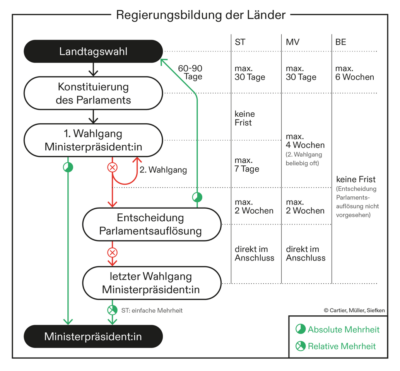
Die drei hier betrachteten Landesparlamente müssen sich innerhalb von 30 Tagen bzw. sechs Wochen nach dem Wahltag konstituieren. So bleibt das Parlament handlungsfähig und die neu gewählten Abgeordneten können rasch ihre parlamentarische Arbeit aufnehmen.
Die Vorgaben zur Regierungsbildung unterscheiden sich aber. Eine Frist für die Durchführung des ersten Wahlgangs existiert nur in Mecklenburg-Vorpommern. Die Landesparlamente von Sachsen-Anhalt und Berlin sind hier zeitlich frei. Für alle gilt dabei: Im ersten Wahlgang ist zum Ministerpräsidenten gewählt, wer die Stimmen der Mehrheit der Mitglieder erlangt.
Ein landesverfassungsrechtlich normierter zweiter Wahlgang existiert in Sachsen-Anhalt und Berlin. In Sachsen-Anhalt muss im Anschluss an den erfolglosen ersten Wahlgang innerhalb von sieben Tagen der zweite Wahlgang stattfinden, bei dem dieselben Mehrheitserfordernisse gelten wie im ersten. Das Berliner Abgeordnetenhaus kann zeitlich ungebunden nach dem ersten Wahlgang einen zweiten ansetzen, bei dem wiederum allein die Mitgliedermehrheit einen Regierenden Bürgermeister wählen kann. In Mecklenburg-Vorpommern kann das Parlament innerhalb von vier Wochen beliebig häufig wählen, gefordert ist stets die absolute Mehrheit. Das steht so zwar nicht ausdrücklich im Verfassungstext, lässt sich aber daraus ableiten.
Scheitern in Sachsen-Anhalt der erste und der zweite Wahlgang, entscheidet der Landtag innerhalb von 14 Tagen über seine Selbstauflösung mit absoluter Mehrheit. Lehnt er die Selbstauflösung ab, findet unverzüglich ein weiterer Wahlgang statt, bei dem zum Ministerpräsidenten gewählt ist, wer die einfache Mehrheit erreicht. Auch in Mecklenburg-Vorpommern steuert die Landesverfassung nach erfolglosem Ablauf der Vier-Wochen-Frist auf die Selbstauflösungsentscheidung zu, für die die Landesverfassung dem Landtag zwei Wochen einräumt. Trifft der Landtag diese Entscheidung nicht, findet am selben Tag eine Wahl des Ministerpräsidenten statt, bei der gewählt ist, wer die meisten Stimmen erhält. Scheitert in Berlin der zweite Wahlgang, reicht im dritten Wahlgang die relative Mehrheit aus, um einen Regierenden Bürgermeister zu wählen. Auch diesen Wahlgang kann das Abgeordnetenhaus – passend zur Regelungsstruktur der ersten beiden Wahlgänge – zeitlich nach Belieben ansetzen.
Selbstauflösung oder Minderheitsregierung
Festzuhalten bleibt: In Mecklenburg-Vorpommern und Sachsen-Anhalt muss der Landtag erst über seine Selbstauflösung entscheiden, bevor er einen Ministerpräsidenten mit relativer Mehrheit wählen kann. Neben den verschiedenen Fristenregimen ist das der prägnanteste Unterschied der betrachteten Landesverfassungen: In Mecklenburg-Vorpommern und Sachsen-Anhalt hat der parlamentarische Rückhalt des Ministerpräsidenten landesverfassungsrechtlich größeres Gewicht als in Berlin, wo ohne sonderliche Hürden eine Minderheitsregierung landesverfassungsrechtlich akzeptiert wird.
In der Vergangenheit ist es in allen drei Ländern stets gelungen, eine Regierung zu bilden. Sowohl in Sachsen-Anhalt (1994 bis 2002) wie auch übergangsweise in Berlin (2001 bis 2002) gab es bereits Minderheitsregierungen, die durch die PDS/Linke toleriert wurden. Tendenziell hat die Dauer der Regierungsbildung dort in den vergangenen Jahren zugenommen. Deutlicher ist aber ein anderer Zusammenhang für Sachsen-Anhalt und Mecklenburg-Vorpommern: Lagerübergreifende Regierungsbildungen (also Große Koalitionen, Jamaika-Koalitionen und Ampel-Koalitionen) dauern mit durchschnittlich 52 Tagen von der Wahl des Landtags bis zur Wahl des Ministerpräsidenten um 30 Prozent länger als lagerinterne (rot-grüne Koalitionen, SPD-Linke, christlich-liberale) mit durchschnittlich 40 Tagen. Die Zahlen über die Dauer der Regierungsbildung in Berlin hingegen sind von einzelnen Verhandlungssituationen geprägt, etwa der nach vier Wochen gescheiterten Verhandlungen über eine Ampel-Koalition nach der Wahl 2001.
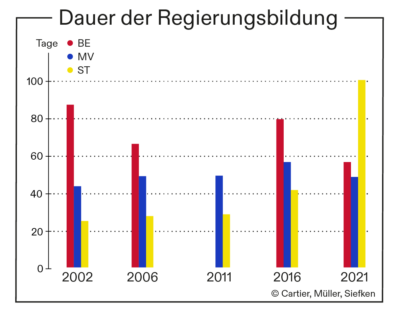
Auch der Umfang der Koalitionsverträge ist deutlich angestiegen: Hatte er 2006 in Sachsen-Anhalt noch 80 Seiten, waren es 2021 immerhin 150. Damit war der dortige Koalitionsvertrag länger als der Vertrag der Ampel-Koalition im Bund. Auch in Mecklenburg-Vorpommern kann man ein Wachstum verzeichnen, das nicht ganz so stark ist: 2002 hatte der Koalitionsvertrag 55 Seiten, 2021 waren es 82 Seiten. Wiederum sind für Berlin unsystematische Ausnahmen sichtbar, die etwa bei der rot-rot-grünen Koalition 2016 zu einem sehr langen Koalitionsvertrag auf 190 Seiten führten.
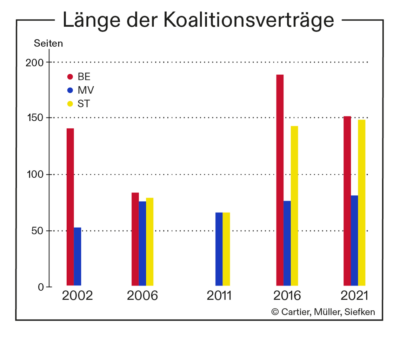
Aus diesen Erfahrungen folgt, was auch ohne die Auswertung der Zahlen plausibel ist: Je heterogener eine Koalition, desto schwieriger und langwieriger wird es, sie zu bilden. Externer Druck, dass der Verhandlungsprozess innerhalb einer vorgegebenen Frist abzuschließen ist, kann dann sogar in den Verhandlungen selbst taktisch genutzt werden. Bessere Ergebnisse kommen dadurch aber kaum zustande.
Eine Frist braucht es nicht
Im Vergleich der Landesverfassungen stellen sich drei Fragen: Erstens, woraus resultieren diese Unterschiede, zweitens, welche potenziellen Folgen haben sie, und drittens: Inwiefern bieten sie den Ländern Gelegenheit, für die Verfassungsentwicklung voneinander zu lernen? Die erste, verfassungshistorische Frage wollen wir hier nur aufwerfen und ihr an dieser nicht weiter nachgehen; sie stellt einen relevanten Forschungsgegenstand für die vergleichende Verfassungsgeschichte dar.
Eine klar definierte Frist für den Abschluss der Regierungsbildung mag zunächst plausibel erscheinen. Die Frist sorgt für zusätzlichen Druck, die Koalitionsverhandlungen zügig durchzuführen und abzuschließen. Insofern wird sichergestellt, dass der neue Landtag rasch seine Wahlfunktion erfüllt, Ergebnisse „liefert“ und eine Regierung ins Amt bringt.
Die politische Realität wird aber 2026 zu komplexen Koalitionsmodellen führen, die fraglos schwerer zu verhandeln sind als rein lagerinterne. Dies resultiert in einer doppelten Herausforderung: Da – inhaltlich – die ideologischen Distanzen größer sind, bedarf es detaillierter Koalitionsverträge. Um diese – prozedural – zu erstellen, ist es erforderlich, mehr Personen in die Verhandlungen einzubinden, um für Akzeptanz innerhalb der Parteien und ihrer Strömungen, sozialen Gruppen und Regionen zu sorgen. Insofern erfordert die zu verhandelnde Koalition mehr innerparteiliches Akzeptanzmanagement, denn auch darauf kommt es in Koalitionsverhandlungen stets an: einerseits mit den künftigen Koalitionspartnern gemeinsame Lösungen zu finden, andererseits auch die eigene Partei „mitzunehmen“ und für den Koalitionsvertrag Unterstützung zu sammeln. All das benötigt Zeit.
Verkürzt man sie, so hat das direkten Einfluss auf die Koalitionsverhandlungen: Ein Koalitionsvertrag könnte kürzer gefasst und allgemeiner gehalten werden. Dies reduziert aber seine Verbindlichkeit und schwächt voraussichtlich die Akzeptanz in den beteiligten Parteien selbst. So dürfte es im Ergebnis schwerer werden, die entsprechende Mehrheit in der geheimen Wahl des Regierungschefs tatsächlich herzustellen. Die unentdeckten Abweichler bei der Kanzlerwahl 2025, aber auch Vorgänge wie bei der erfolglosen Wiederwahl von Heide Simonis 2005 sind hier mahnende Beispiele.
Zudem können die Parteien den Ausweg wählen, sich im Koalitionsvertrag mit „Formelkompromissen“ zu begnügen und insofern die eigentlichen inhaltlichen Verhandlungen in den politischen Gestaltungsprozess nach der Regierungsbildung selbst zu verlagern. Das würde die aufwändige politische Koordination innerhalb der Koalition aber nur verlagern – von den Verhandlungen ins Regierungshandeln. Die Konsequenz wäre, dass gesetzgeberisches Gestalten der Koalition länger dauern würde. Den Gewinn einer schnell gebildeten Regierung würde man sich also dadurch erkaufen, dass diese Koalition schwerfälliger wäre.
Sicherlich ist es wünschenswert, bald nach der Landtagswahl auch den Regierungswechsel herbeizuführen. Dabei muss man aber beachten, dass Fristen gerade das erzeugen können, was sie eigentlich verhindern sollen: eine instabile, schwach legitimierte Regierung. Denn, wenn man die verfassungsrechtlich vorgegebene Geschwindigkeit nur dadurch erreichen kann, dass eine wacklige Koalition entsteht, ist das weder für das Regierungshandeln noch für das Staatsvertrauen sinnvoll. Eine Frist, die eigentlich dazu dienen soll, zügig eine handlungsfähige Regierung hervorzubringen, kann Not-Koalitionen produzieren, deren parlamentarischer Rückhalt schwach ist und die sich daher als handlungsunfähig erweisen.
The post Ohne Frist – ohne Druck? appeared first on Verfassungsblog.
